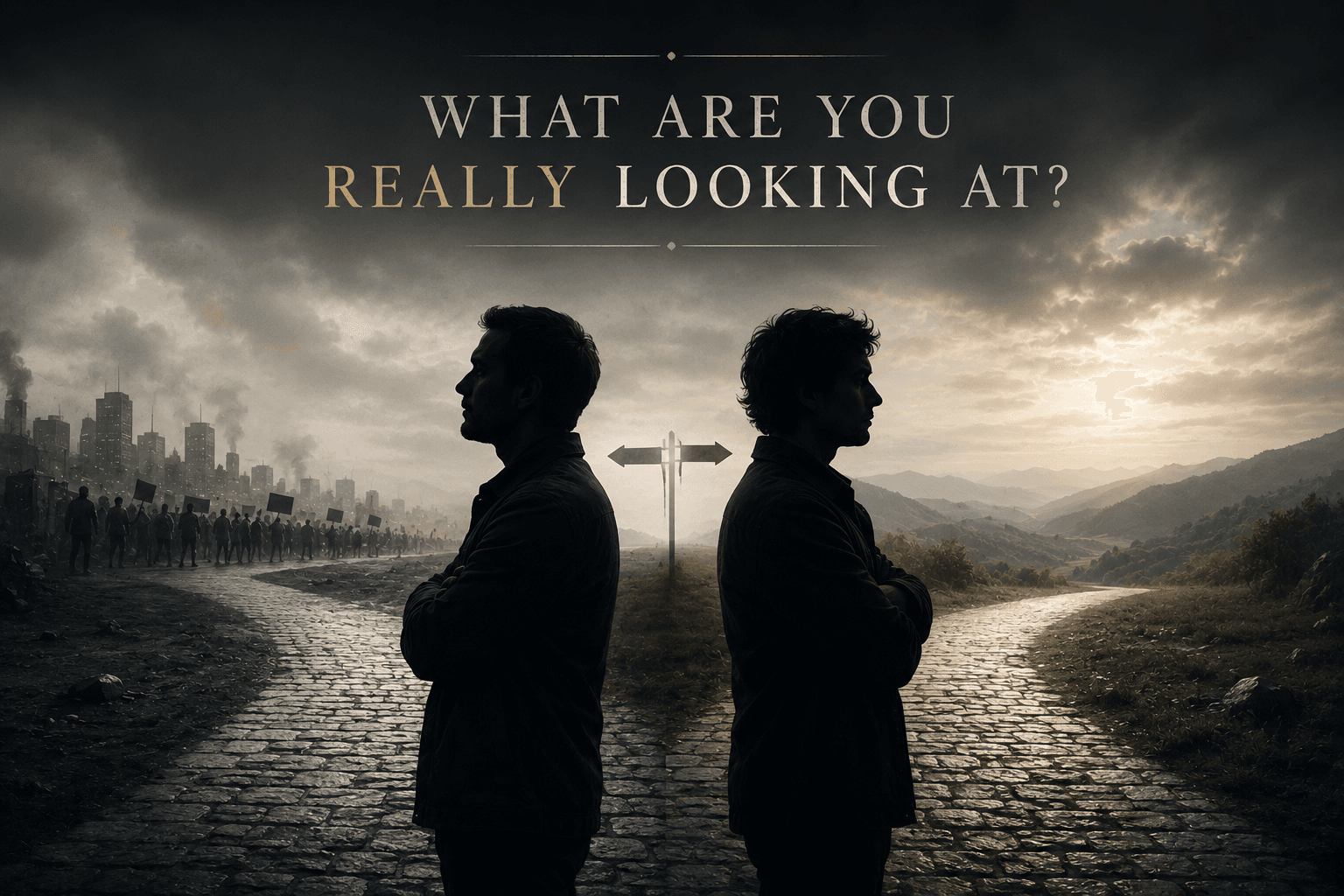
What Are We Really Looking At?
Shut up! I agree with you.
Why do we see the world the way we see it? Why do some of us look at a problem and feel the immediate urge to react, while others look at the same problem, take a breath, and walk away? What are the drivers that make some react as though the issue is the ending of the world as we know it, while others turn on their heels and walk to the library to seek some knowledge before voicing an opinion?
From a behavioural analysis perspective, the answer lies in the fact that none of us experiences reality directly. We experience our interpretation of reality.
Every person views the world through a lens constructed over decades: genetics, upbringing, education, culture, personal experiences, successes, failures, traumas, relationships, beliefs, and values. By the time two people encounter the same problem, they are not really seeing the same problem at all. They are seeing different versions of it through different filters, and both images can be blurred.
Some individuals perceive uncertainty as a threat. Their brains are wired, through experience and/or temperament, to prioritise action. Ambiguity, for them, is not control, and therefore, they are compelled to respond immediately to regain the sense of control. Such action is a coping mechanism when delay can feel like weakness, indecision, or even danger.
The flip side of that is perceiving uncertainty as a puzzle rather than a threat. Such individuals are comfortable in their own silence, sitting with incomplete information while striving to derive confidence from understanding rather than acting. Before forming an opinion, they instinctively seek context, evidence, and alternative explanations. To them, immediate reactions can appear reckless while thoughtful restraint is a sign of strength.
This is where intelligence analysis offers such an interesting lesson. No matter the event, bumping into someone you have not seen in a while, the first encounter at a business meeting, or a street fight! No matter what the event, sense what your first interpretation of the event reveals by asking a different question from the one you would expect. Ask not, “What am I seeing?” but instead, “Why am I seeing it this way?”
The person who reacts with outrage may be responding to perceived threats to deeply held values. The person who walks to the library may be responding to an equally powerful belief that truth should precede judgement. Both are behaviours driven by something beneath the surface. This, therefore, begs the question: why are we surprised when people disagree?
When we understand that every opinion is built upon a unique combination of experiences, incentives, fears, values, and knowledge, disagreement becomes less mysterious. It becomes expected. When something is expected, the real skill is learning to recognise the lens through which we are looking and having the humility (or common sense) to accept that others may be looking through a very different lens.
Then again, if this sounds like a load of codswallop, there is always the Dunning-Kruger effect to consider!